
The announcement comes two days ahead of the proposed historic launch of the ISRO's 100th satellite along with 30 others in a single mission from Sriharikota.

Aditya-L1 will be launched by PSLV-C57 rocket on September 2 at 11:50 am. It carries seven payloads to study the Sun, four of which will observe the light from the Sun and the remaining three will measure insitu parameters of the plasma and magnetic fields.

The city houses National Remote Sensing Centre and is also home to several companies offer geographical information system services.

XPoSat or X-ray Polarimeter Satellite is India's first dedicated polarimetry mission to study various dynamics of bright astronomical X-ray sources in extreme conditions.
He also said it may be adopted for use in every stage of a rocket. He was speaking at the 16th convocation of SRM Institute of Science and Technology, near Chennai.

Humans will work far more collaboratively with artificial intelligence for rapid and complex decision-making.

The PSInSAR satellite technique used to observe the gradual sinking of Uttarakhand's Joshimath town is a powerful remote sensing tool capable of measuring and monitoring displacements in the Earth's surface over time.

Chandrayaan-3 mission's rover 'Pragyan' has traversed a distance of about eight metres on the lunar surface, and its payloads have been turned on, ISRO said on Friday.
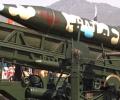
"We estimate that Pakistan now has a nuclear weapons stockpile of approximately 170 warheads. The US Defense Intelligence Agency projected in 1999 that Pakistan would have 60 to 80 warheads by 2020, but several new weapon systems have been fielded and developed since then, which leads us to a higher estimate," the Nuclear Notebook column published in the Bulletin of the Atomic Scientists on September 11 said.
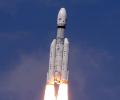
'ISRO takes a very cautious approach.' 'After reaching the moon, the orbit has to be brought down from a single elliptical orbit to a circular orbit while simultaneously ensuring the stability of Chandrayaan 3 and the health parameters of the lander and rover.'
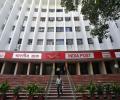
The Postal Department has geo-tagged more than 1,50,000 post offices on geo-portal Bhuvan, developed by ISRO
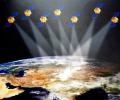
In the years to come, India's space assets will play a much bigger role if and when hostilities break out on our borders, says Pallava Bagla.

The record temperatures in May were accompanied by other extreme events, including very heavy precipitation in parts of Europe and the southern US, and widespread and severe coral reef bleaching.
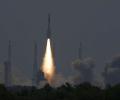
A dome-shaped mysterious object has washed up on a remote Australian beach, amid speculation that it could be from a 20-year-old Indian rocket that was used for launching a satellite.

Deciphering its secrets will unlock the early history of not only our planet, but also of the star system, explains Kumar Abishek.
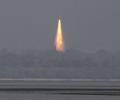
Enthused over its successful launch of GSLV D5 with GSAT-14 communication satellite from Satish Dhawan Space Centre in Sriharikota on Sunday, the Indian Space Research Organisation is planning a series of GSLV launches and an experimental launch of the advanced version GSLV Mark III soon from the spaceport.
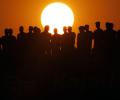
Solar Orbiter is on a unique trajectory that will allow its comprehensive set of instruments to provide humanity with the first-ever images of the Sun's poles, the US space agency said. This trajectory includes 22 close approaches to the Sun, bringing the spacecraft within the orbit of Mercury to study the Sun, and its influence on space, it said.

A NASA satellite, orbiting one million miles away, has captured stunning images of the Moon passing the Earth's sunlit side, which show the 'dark side' of the lunar body that is never visible from our planet.

Billionaires are not only eyeing a profit as they push mankind out into the stars.
It appears India will be among those nations consigned to being among the watchers and not participants of this crucial phase, observes Aakar Patel.
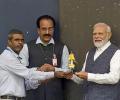
'Perhaps the government should explain how the same scientific temper, which authored a precise landing for Chandrayaan-3, finds the periodic table and the theory of evolution not good enough for inclusion in the educational curriculum,' asserts Shyam G Menon.

'When the Americans are talking about colonising Mars by 2030, India cannot be lagging behind.'

ISRO chairman A S Kiran Kumar talks of what's on and what lies ahead for the Indian space agency.

China's National Space Administration landed the Chang'e 4 lunar probe at 10:26 am Beijing time on Thursday, in the South Pole-Aitken Basin which is an impact crater, China Central Television reported.

'Everybody spies on their friends as well as their enemies. That's the way the world works these days'

ISRO has an opportunity to be the one-stop shop for satellite manufacturing, and Alpha Design is just the booster it needed.
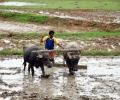
IMD has decided to increasingly use cutting-edge technology such as artificial intelligence (AI) and machine learning (ML) in forecasting, both to avoid such glitches and to counter the disruption of normal seasonal patterns as a result of climate change. It has formed various internal sub-groups of senior officials and meteorologists to decide on how best to use AI and ML in predicting cyclone intensity, and in making short-range weather forecasts (those valid for up to three hours) as well as long-range forecasts.
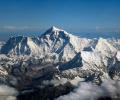
For one, triangles are involved.
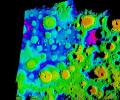
Astronomers have created a new lunar topography map with the highest resolution of the moon's rugged south polar region, which they claim provides new data on some of the Earth's natural satellite's dark craters.

This year's 'Opposition of Saturn' is considered the brightest till the 'opposition' on December 11, 2031, according to Akash Ganga Centre for Astronomy at Badlapur at Thane district.

Pompeo will travel to India, Sri Lanka, Japan and South Korea from June 24 to 30. His four-nation is aimed at deepening US partnerships in the strategic Indo-Pacific region.
"The first lesson from the Indian ASAT is just the simple question of why did they do that. And the answer should be, I think to all the committee looking at it, is that they did that because they are concerned about threats to their nation from space," US Strategic Command Commander General John E Hyten told members of the powerful Senate Armed Services Committee on Thursday.

Climate change has hampered the ability of the forecasting agencies to accurately predict severe events and weather bureaus across the world are focusing on augmenting the observational network density and the weather prediction modelling to improve predictability, India Meteorological Department (IMD) Director General Mrutyunjay Mohapatra has said.
NASA has released the first-ever 360-degree panoramic images of the Sun. Two Solar Terrestrial Relations Observatory satellites, launched in 2006, have gradually been drifting apart -- one in front of the Earth in its orbit, the other lagging behind.

'ISRO facilities are very expensive and any damage caused by these start-ups can create havoc to our space programme.'

Thirty-four years after he traveled to space, Wing Commander Rakesh Sharma tells Rediff.com's Archana Masih that he looks forward to Gaganyan, India's first manned space mission in 2022.

Pyongyang wants the world to recognise its nuclear capability, says Srikanth Kondapalli.

Just over 22 minutes into the flight, the rocket put Astrosat into orbit at an altitude of 650 km above the earth
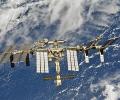
Once ISRO masters the technology to send humans into space, the next step will be experimenting with technologies allowing humans to live in space.

A quick recap of the Mars Orbiter Mission's major milestones on the way to Mars

The Chang'e-4 spacecraft scripted history on Thursday when it made the first-ever soft landing on the far side of the moon.
 © 2026 Rediff.com - Advertise with us - Disclaimer - Privacy Policy - Sitemap - Feedback - About us - Terms of use - Grievances